

How to spot the Facebook scam competitions which you’ll never win!

by Sam Davis
Every day I log on to Facebook to find people sharing and liking Facebook competitions from organisations like “Center Parcs”, “British Airways”, and “Virgin Holidays” – all of which promise wonderful once in a lifetime getaways. These promotions, whilst they may look legitimate, are sadly anything but genuine – and this blog post has been written to ensure that you’re aware of these fake contests, because as harmless as they may seem – they can have a darker side.
In a world where people choose to shred their own snail-mail to prevent identity theft and will seldom disclose information over the phone to renounce cold-callers, there are still swathes of people who unfathomably opt in to these fake contests – all of which have no terms and conditions, no closing date, and unsurprisingly – no winners.
Ok clever clogs, so the competitions are fake – what does it matter if I “Like” them?
You’d think that by simply liking the page, sharing it, or tagging your friends in a post – you are doing no harm. Well, in a way you’re not – as you’re not parting with any cash as such, so what’s the problem in simply entering a free competition, regardless of whether it is legitimate?
The new owners of these “phishing” pages are often scammers who end up marketing dodgy products and services.
Well, it CAN be harmful.
The tactic is known as “like-farming”. The aim of these pages is to increase the value of the Facebook page. You see, the more “likers” a page has, the more money the owner can sell it on for. Thereon, the subsequent owner of the page can rename, rebrand, change all the content – and guess what – you’ll still be a “liker” of the page. The new owners of these “phishing” pages that you subscribe to are either scammers who end up marketing dodgy products and services – or they will simply be purchasing the pages in order to flip them on later down the line for more money.
 It’s actually worth reviewing all the pages that you have Liked previously on Facebook, as, if you have liked more than 20 pages on Facebook (which, lets face it – you probably have), statistically there is a 73% chance that one of these pages will have since rebranded and become “something else”.
In the Center Parcs instance, the competition which I spotted today, had been running for 7 hours, had already garnered 16K likes, 6K comments, and over 64K shares – absolutely scary. Unfortunately, the number of likes a status receives can act as social proof – therefore people think it’s real – after all, 64,000 people can’t have got it wrong surely? Similarly, the more likes a Facebook post gets, the higher it will appear in people’s news feeds – so by liking the page, you’re giving fellow Facebookers more of a chance of seeing the spam.
So lets analyse this particular contest.
“Center Parcs” were asking users to sign up in order to “win a holiday for four people”. It’s rubbish. There is no prize. The competition is fake. To save you the bother of seeing what happens, I have gone through the process of what goes on when you submit your information. This is what happens…
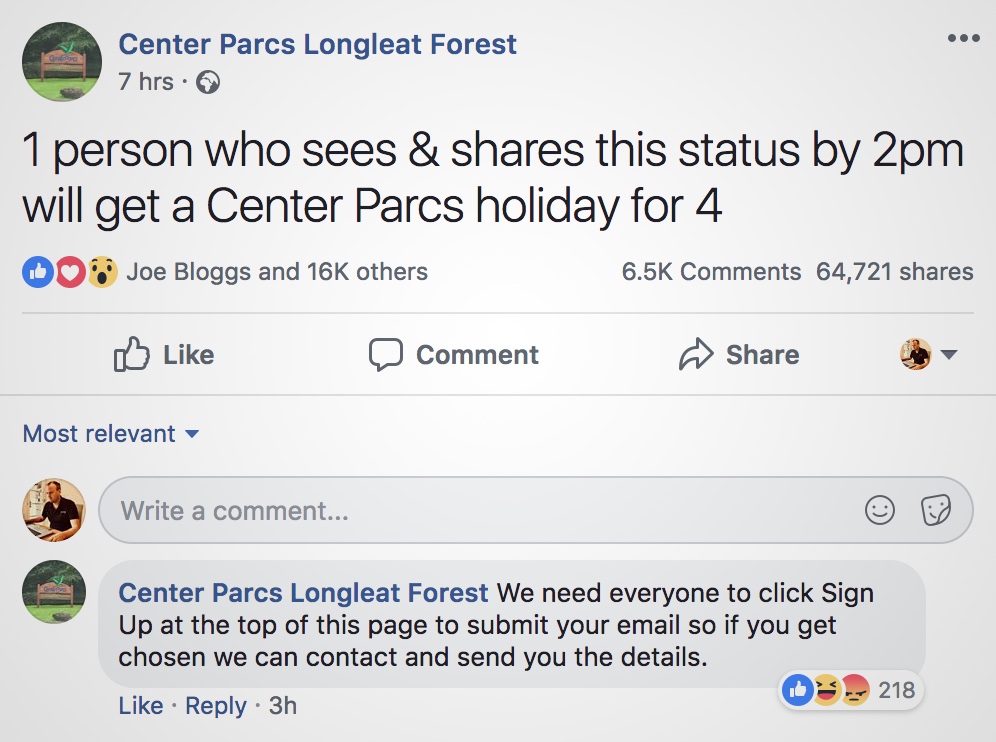
1) Here is the Center Parcs competition, together with the desperate “we need everyone to sign up” message.

2) I proceed to click Sign Up, and it takes me off to a random page with a Center Parcs logo…

3) I have now clicked “I Confirm”, and I’m then greeted by a page which is now asking for my particulars.
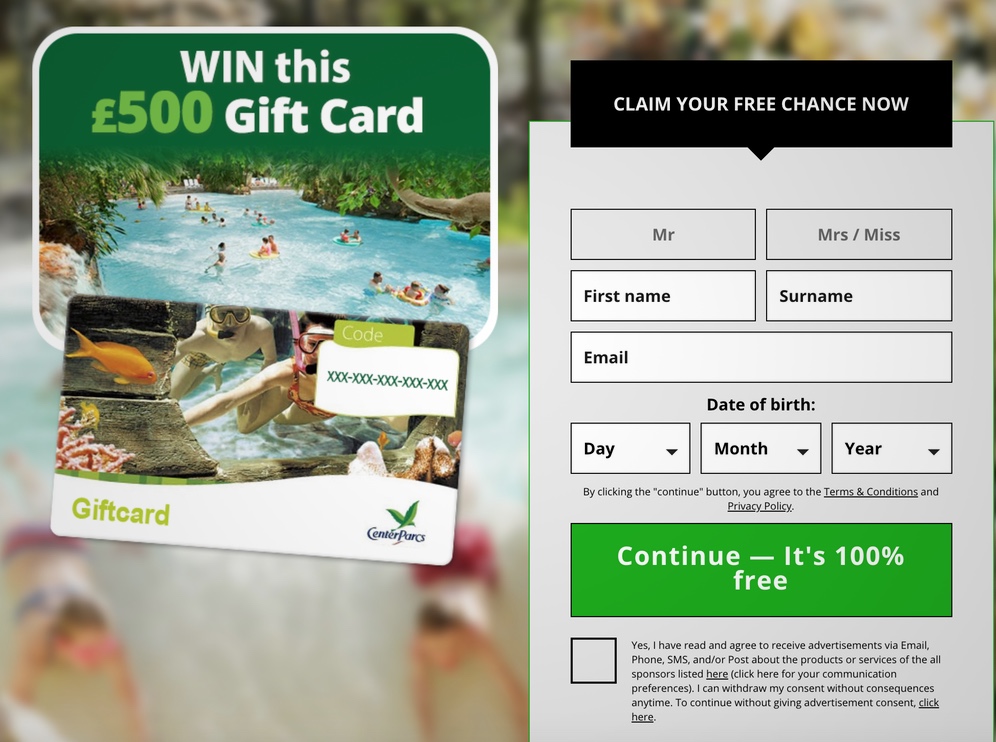
4) The form asks for email and my date of birth – it’s handy for advertisers to market their goods to targeted age sectors.
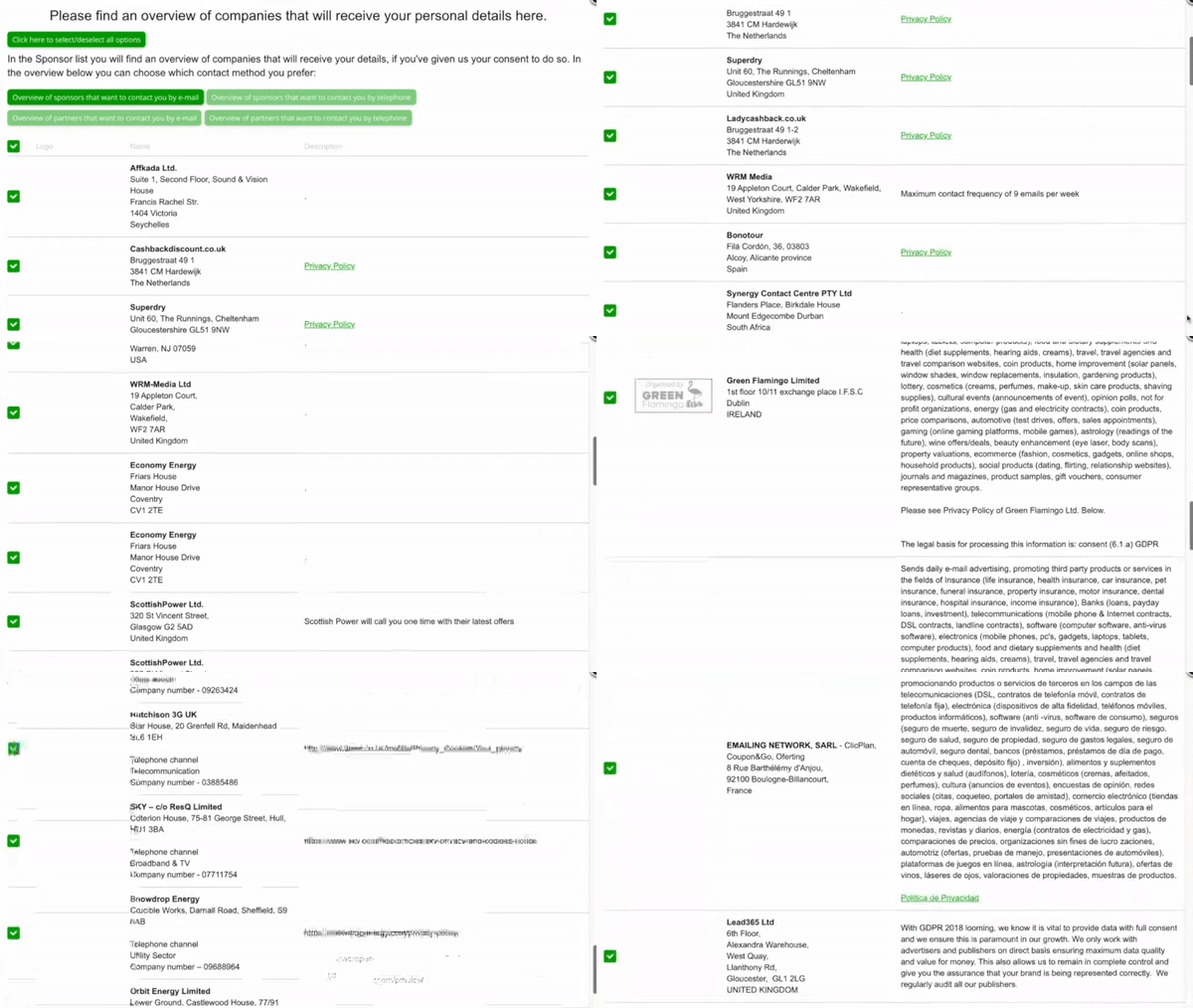
5) The Privacy Link on the form leads to the following page, which shows you all the companies that they are going to sell your information to – don’t worry, it’s only just the 33 companies who will get your details, no biggie.
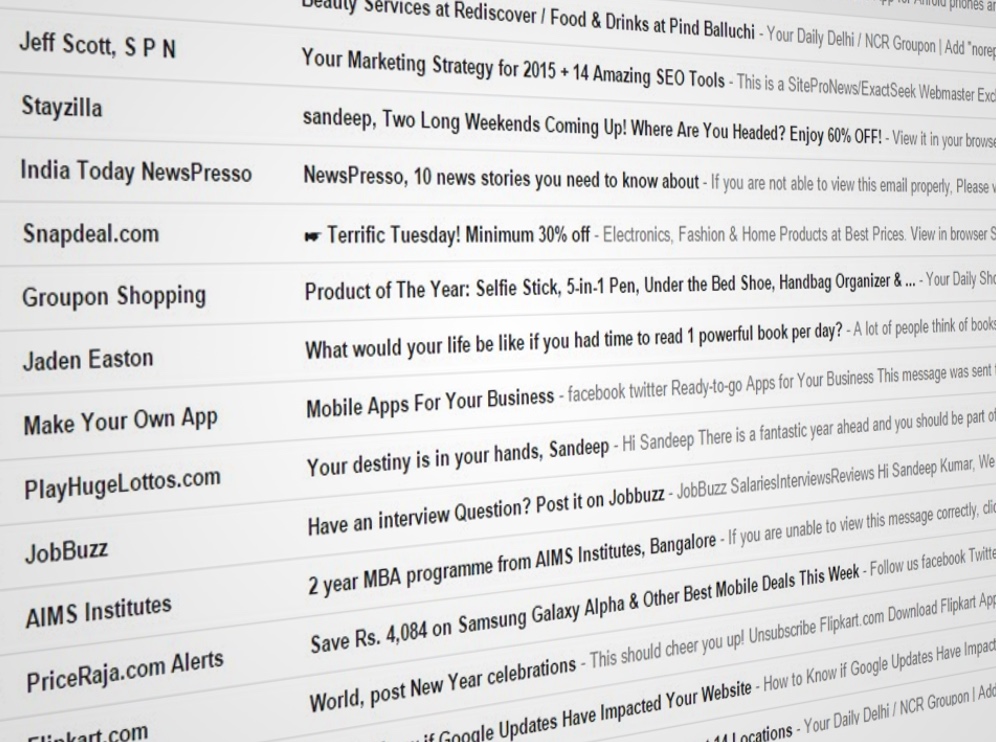
6) I’ve submitted my details, the 33 businesses now have my details – and now, after receiving 2 Junk emails in the last 24 hours, I now have had 18 in the space of three hours. Joyful!
Of course, this is just one example of what can happen. There are other scams where companies will send you text messages daily which cost you £1.50 a pop, some will try and get your debit card details for “verification purposes” (yeah right), and then there are those who will simply bombard your email and phone daily with cold-calls and scam promotions.
 There are a number of popular reputable companies that have been targeted with these scams – you’ll see pages out there for British Airways, Sainsburys, TUI Holidays, Virgin Atlantic, Thomas Cook to name but a few – all of which are totally fake. You’ll see the logos, the branding, they may even display a legitimate phone number on the page – plus, on occasions you’ll see a “photo” of the member of staff who is purportedly posting the update. It’s all 21st-century fakery.
So, how can you spot a fake page?
- Firstly, use your instinct. Sainsbury’s are not just giving away 2500 iPad’s out of the goodness of their own hearts – it just doesn’t happen.
- Look for the blue tick. All large companies will have a blue tick to show they are verified next to the name of the business. On the seldom occasion that a company doesn’t have one, simply visit their website and click the Facebook icon.
- Look for the small print. Even the most simple newspaper competition will have a biblical amount of wording to clarify the rules of the competition – if they have no Terms and Conditions, well the prize is simply not going to materialise.
- If the competition has a link or a button, if you click it and you end up on some random domain name that is nothing to do with the company in question, it’s likely to be a hoax.
- Does the page have ANY content previously, or is this the first post they have produced? If so, then you’re almost certainly seeing a hoax page.
- Check the page creation date – you can do this by checking the Information link on the left hand-side of the page. It will show when the page was established and whether the page name has changed. It the page was created in the last couple of weeks – again, it’s a scam.
By taking note of the six rules above, hopefully you’ll think twice about entering the competitions. By doing so, you’ll stop the scammers getting what they want, and simultaneously, you’ll stop your friends seeing your interactions with the contests – thus preventing one of them getting diddled too!

Sam Davis
I am fanatical about providing useful web experiences, via bespoke websites which engage, inform and entertain. I have been making websites since a young age, and am a keen supporter of AFC Bournemouth.